Thursday, September 24, 2009
OMG!! Hilarious!
Cinematic Truth and Curiously Strong Mints

For the last several years Altoids has been running highly-stylized print ads that draw on cinematic motifs of the 1950s and 1960s. Playing on the classic themes and situations of early films and television these retro-fit ads seem more absurd than nostalgic; a mode of production in which the denotations are alienated from their connotations, forcing them to negotiate the mechanisms of imagery. This is largely due to the lighting (which is cinematic) and the color (which is unnatural and clearly the result of post-production.)
The use of these "elements" not as subtle processes of design but as deliberate mechanisms of image production force us to consider the narrative "truth" of this image on several different levels and modes of reality. First there is the construction of a social myth (the tableau of a boy being caught masturbating by his mother), secondly there is the re-construction of a certain era or cultural sensibility (that being/ belonging to the 1950s and 60s) and lastly there is the appropriation of these two modes by the advertising industry for use in another context entirely.
Cloverfield
Here is a trailer of the movie:
Editing for Rhythm in Delicatessen
Wednesday, September 23, 2009
"I Sawr Him. I Know It Was Him."
Younger, imaginative, precocious sister has a crush on gardener. Gardener loves the older, wiser, level-headed sister. Younger sister sees gardener and older sister doing it. Younger sister thinks it is rape. Later, a house guest is actually raped by someone. Younger sister with the crazy imagination concludes that it is the gardener and becomes a tattle-tale. Gardener is sent to war to fight. Love is put on hold. Lives change forever. Everyone cries and some people die.
I should win a Pulitzer for that.
Anyways, if you haven't seen the movie, go and see it because it is so good. I have the DVD; you can totally borrow it.
Director Joe Wright is brilliant at employing POV in order to heighten the effect of Briony's imagination. In the first few scenes of the film, Wright uses the first person POV when we see an incident through the eyes of Briony:

The audience sees what she sees and we immediately see her own reaction to what she had just seen. We can interpret what she is thinking through her facial expressions: confusion, intrigue, gossip, etc.
Later on, Wright employs the omniscient POV to inform the audience of the reality of the situation:

In these screenshots, the camera work is subtle and always still, to give the impression that we are observing what is going on. Thus, as the article stated, we are given "a comprehensive exposure to the people and events depicted in the work" (208).
Here is the clip of that scene:
In the middle of the movie, Wright also employs the second person POV during Briony's testimony:

In this scene, the camera goes from third-person POV to second-person POV. We take the role of the interrogator and Briony tells us that she, in fact, "sawhrrr him."
"You sawhhrr him? You know it was him?"
"I sawhrr him. Yes, I sawhrr him with my own eyes."
Finally, I want to refer to the ending of the film, which I considered to be an amazing final scene. In my intepretation, I viewed it as utilizing first-person and second-person and third-person POVs, because we were observing the interview, experiencing older Briony's thoughts and viewing her reasoning while we simultaneously take on the role of the interviewer hearing her confessions.

In this riveting, final scene, we see the transition from third-person POV to second-person POV when the area around Briony's visage turns to pitch black and when she is, of course, looking straight into the camera as if staring at us. Thus, we take on the role of the interviewer as if she were answering our question.
This final scene uses a camera shot which the article mentions called the gaze (207). We see the scene transition from second-person POV to first-person POV when Briony confesses to fabricating things for the sake of a happy ending for Robbie & Cecilia and sharing her general feelings about her past. As the scene progresses and cuts to Briony, the shot's proximity lessens and lessens until we are left a fierce close-up of her face. Indeed, she is talking to us and she is exposing her "mental state."
Camera Movement - Bonnie and Clyde
Bonnie and Clyde, played by Warren Beatty and Faye Dunaway, are bank robbers in love. Throughout the movie (which takes place during the Great Depression), they have stolen and killed their way through the American Midwest and have earned themselves a top spot on the Most Wanted list. At the end of the film, they are set up to be executed by the police. Most of the action starts about halfway through the clip.
The differing speeds at which this scene is shot reveals the complex elements surrounding Bonnie and Clyde's downfall. The events portrayed on camera are in 'real time' until Bonnie and Clyde look at each other and realize what is about to happen. Then, the screen cuts back and forth between the two rather quickly and unevenly. In this manner, Bonnie, Clyde, and the viewer all figure out what is happening at the same time. There is almost a resistance from the audience because there is a general instinct for dramatic moments, such as two lovers seeing each other for the last time alive, to be drawn out in films. However, it appears that the director, Arthur Penn, is trying to remind everyone that real life action doesn't really happen that way by deciding to use these camera techniques.
We are thrown back into "real time" once the shooting begins. Then, the reverse effect occurs - the camera slows down certain shots in order to dramatize the violence. The article states that "media communicators sometimes use slow motion to create a romantic or poetic mood." The slowing down of the action here definitely adds an artistic element to Bonnie and Clyde's deaths, especially Clyde's. Due to the effects of the camera, his fall is portrayed as somewhat graceful, like a perfectly choreographed dance. However, just when the audience gets used to the slow shots, the movie kicks back into gear, and Clyde's death doesn't seem so beautiful anymore as he is showered in bullets.
There are many different ways to analyze this violent scene because of the unique use of camera speed. Many filmmakers still debate as to whether this scene criticizes violence or valorizes it. Either way, through the use of camera movements, Bonnie and Clyde shows how a seemingly simple event can have many complex factors.
Br00tal Grind(house)
Planet Terror, directed by Robert Rodriguez, is basically a standard zombie movie, and fitting with that genre has an incredibly dark vibe to it. The movie is shot almost entirely at night (I can't think of a single daytime scene off the top of my head), and when the characters do venture indoors (the hospital especially) the light is harsh, which makes the death and sickness being portrayed seem harsh as well.
After Planet Terror ends, we are suddenly transported down to Austin, TX for Deathproof, a film that is almost entirely set during the day, bright sunlight shining. I remember being in the theater, and during the opening sequence (below), I felt like squinting.
It is pretty significant that the only night-time scene in Deathproof is the actual death scene halfway through the film. Deathproof is actually quite the uplifting movie, and I think a lot of that is because of the lighting choices.
I can't believe I got one of these posts done before midnight.
Everyone's Waiting
Temporal Editing in Slumdog
The best modern example of temporal editing has to be the 2008 Oscar-winning film, Slumdog Millionaire. The film weaves seemingly irrelevant flashbacks of the main character’s (Jamal Malik) life into the body of the film to help make sense of its present events. The life experiences of Malik that the film flashes back to explain his ability to answer the tough questions on the popular game show, “Who Wants to Be a Millionaire,” which (in the film) he is currently a contestant of. The insertion of the flashbacks creates depth and meaning in the plot and draws an emotional response from the audience. With such a heavy presence in the film, the production element, temporal editing, is central to the audience’s comprehension of the storyline of Slumdog Millionaire.
Unfortunately, the best video clip that I could find of temporal editing at work in the movie is the trailer. The way that it displays an equal share of clips from the movie’s flashbacks as well to its current moments reveals just how important the production element is in the overall effect of the movie.
Trapped In My Own Body
At Merlotte's!: True Blood as a Sitcom
Sans the Comic Sans

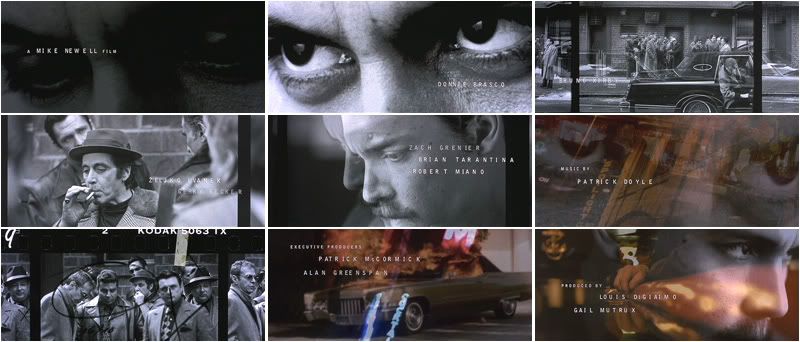
This is great and all, but since those are static and the article already discussed the mastheads of such publications, I'm going to dive into movie titles and opening/closing credits where it's not just in print and not just a stamped brand, but instead moves and floats in space while introducing or concluding a feature film.
I'll start with a title of one of this year's summer films Ponyo (2009):

It's like summing up the entire theme of the film in not just in the word itself, but the style it has been designed. The custom font is thick with tiny "bowls" (technical term for the hole) in the O and a nice swishy wave at the bottom of the N. The title alone signifies that this is probably a children's movie that might take place underwater, rather than a horror film like Saw, which uses a disgruntled, dirty look.

(Click any image to see it larger)
"A Unique Sound"
Tuesday, September 22, 2009
All those problems will "Wash Away"
This is one of the cutest commercials that I've seen in a long time. The commercial is for Dawn. The ad sends a message that Dawn is so gentle that it can wash away the oil spills that trap innocent animals, without hurting them at the same time. It also urges people to buy Dawn, because a part of the profit will be donated for this cause.
But the directors of the ad did a great job with the production elements (and most specifically, with the color and the music).
COLOR:
The entire commercial is situated on a blue background that is supposed to resemble a clear blue water of the ocean. The fact that the blue background isn't dark but light, makes the entire scene more relaxed and calm. Also, because the blue background is so vivid, it makes the animals in the commercial even more lively.
BACKGROUND MUSIC:
The choice of the background music was simply perfect! As the commercial starts off, the audience see a duck covered in the oil spill, while we hear "I got troubles although, not today" as the background music. This reinforces the idea that even though the duck is hurt by the oil spill, the problems will soon go away. And then as the person used Dawn to wash the oil spill off the duck's feathers, the audience hear the background song lyrics: "'Cause they're gonna wash away." And as the commercial nears the end, we hear the still cheerful background music (which seems to be played by an ukulele- which also happens to symbolize a cheerful state of mind) and we see other sea creatures like the sea otter and the penguin being happy, after the oil spill were washed away from their fur and feathers.
I just simply love this commercial. Not only is it cute because it shows these three cute animals being helped, it also reminds me of the always-fun bath time that younger kids simply adore. And I'm sure that with that specific background color, the specific cheerful music, and the imagery of a bubble bath, this Dawn commercial definitely reached its desired audience (housewives who are conscious of the environmental issues, as well as mothers whose young children might be charmed by the cute animal actors), and became a success.
Jennifer's Body Trailers
"Fox is putting a trailer of Jennifer's Body in front of Bruno this Friday. Great, right? Only problem is it's not our trailer. It's kind of a straight horror preview and while we're sure it'll appeal to many of you, we wanted to make sure you guys got to see our cut... Lets call it the "filmmaker's cut". We think it captures the comedy and scares of the horror films we grew up on - a kind of nostalgia for when horror films were fun. Can't wait to show you the whole film... In the meantime, here's the red band trailer we wanted our fans to see."
- Karyn, Diablo, and Jason
And here's the one we saw in class to compare:
How to Embed Videos
From Hulu:
From Yahoo! Video:
EVERYONE PLEASE MAKE SURE THEIR IMAGE LINKS AND VIDEO LINKS WORK! I wrote a post on URL and image linking the other day that might help. If it's still not working, try the Blogger Help Section.
If you've done all this, followed all the instructions in the videos and help files, and it still doesn't work, please post the issue that you're having in the comments to this post so I can help you figure it out.
Jaws
Since Jaws is such an old movie it was incredibly difficult to find scenes from it, and this one particular scene which I wanted only came in a trailer-like form. Anyway, when you guys watch the clip please ignore the man that is talking over it and you can stop watching once the woman is attacked. Sorry it's such a bad clip!!:
This is a very simple scene, just a pan shot of coral and a woman swimming in the ocean, and yet the incorporation of sound effects manages to transform what would originally be perceived as a serene shot (at least until the woman is seen thrashing about) into a highly suspenseful one. In this scene all one can hear is nonliteral sound, the beats are low pitched and slow but gradually get faster and louder and more high pitched to signify a sense of foreboding and that danger is getting imminently closer. “A movie is made up of many, many details, and nothing is more important than the music,” (Analysis of Production Elements, pg. 239). Sound can really help to create a mood; imagine if the song that was playing in the background was something cheerful and upbeat-no one would have any sense of fear and that would take away from the entire scene. “Musical cues tell viewers how to feel about what they are watching,” (Analysis of Production Elements, pg. 239). In this scene, not once is the shark shown and yet viewers know that they are meant to feel a sense of fear and suspense. I think Jaws proves that sound is just as important as what is being shown visually-Jaws is associated with its soundtrack, viewers remember it now because of its suspenseful music. I’m pretty sure this music is familiar to almost everyone even if they haven’t seen Jaws proving that sound can have a deeper impact than the visual aspects of a movie itself!
Now imagine if Jaws had sounded like this:
By the way could someone please tell me how I can post videos on the blog?? I'm not very tech savvy.
Special Effects seen in "Twister"
When it comes to well-done special effects, one of my favorite movies comes right to mind, Twister. If these don’t look like real F-5 tornados, then I don’t know what does. The special effects used in this movie do not only include constructing numerous tornados that resemble various F-1 to F-5 treacherous storms, but tractors, tankers, and cows were also easily created in a computer environment all with a little magic from Hollywood.
This YouTube video shows really well what exactly goes in to making this movie seem as real as they can be. Things such as color, lighting, and speed are all taken into account when designing a real life tornado because good visuals are a key concept in convincing the audience that what they’re looking at is actually happening. (Of course, similar sounds are helpful, but if you’re anything like me or most people these days have to “see it to believe it!”)Special effects teams today can create just about anything known to your imagination. As discussed in the reading, one of the most common tricks of special effects are used when a team constructs a miniature model of something they want to appear real. In the example for this movie, that could be a cow flying across the screen as if were being blown by the winds of the tornado. Obviously this couldn’t be reenacted for real life filming, but instead, filmmakers constructed a mini version of a cow and made it appear real by “overcranking” the camera at a faster than normal speed. This is also commonly used in movies such as King Kong with the humungous gorilla who held up lifesize trolly cars, or the building size t-rex in the movie Godzilla. It can even be used for objects that are not living, such as constructing the great Emerald City for the film The Wizard of Oz.
All in all, I feel that when it comes down to deciding if a movie was good or not, it really comes down to the special effects seen in the movie. If you felt like you were right there in the middle of the action, then the filmmakers did their job. And if not, it’s usually a pretty big disappointment because listening to actors walk and talk can only take you so far. Can you think of any other examples from movies in which you think the special effects teams did a great job in making something seem very realistic?
Record Labels as Branding
I have always known that my music habit has been the privilege of a consumer society, but the similarities between picking out the best record at Other Music and shopping for clothes at Macy's was almost shoved into my face while reading Chapter 7. In indie music culture branding is inescapable, and basically essential for a band's survival. Record labels are a symbol of cool, and when record buyers go into stores, in general they will search for the label as some sort of indicator as to whether or not they should purchase that record, tape, or CD. Collectors search out old records on labels by bands they may have never heard of just because they carry the seal of approval that the label connotes.
I have run out of time before class starts, so I'll post this now, but I'm going to come back to this after class and finish my ideas!
Coca Cola strikes DESIRE
The Brand. It’s what keeps people hooked. Without our want/need for the brand it would never sell. To sum the goal of advertiser's up in one word: Desire.
The role of the brand is central to commodity culture. Instead of a “real” world of objects to which advertisements refer, we see the emergence of a culture in which the image itself is what we live though and consume. Sturken & Cartwright state that,”Identity is no longer the signifier of a product. Rather, identity is the pure product that we consume, either as information or as image” What makes advertisements as powerful as they are is that they are lived through the insignias and logos affixed to the products we use, or the food we eat. Take the insignia of CocaCola for example:


It’s no stranger to any of our eyes, for we’ve seen this at sporting events, billboards in Times Square, on TV shows such as American Idol where it is so vividly displayed on the judging table, it’s even in magazines and papers brought to our front doors. The goals of Coke manufacturers consist of getting us to identify their products with quality. They want to make it CRUCIAL that we find enough purpose and desire toward their product that we want to continue to buy its name BRAND over the next generic type. In order to do this, Coke brands itself with celebrities, classy events, and anything they feel the average consumer would DESIRE. Because in the end, that’s what it’s about: our wants and desires. If Coke can retain these distinguishing features, then it will be a successful product. People recognize the logo and want to be apart of this brand. Sturken and Cartwright seem to have nailed advertising on the nose because they know exactly what we, as consumers, are looking for in our brand name products. And it proves to be true because it sure looks like Coke has been pretty successful!